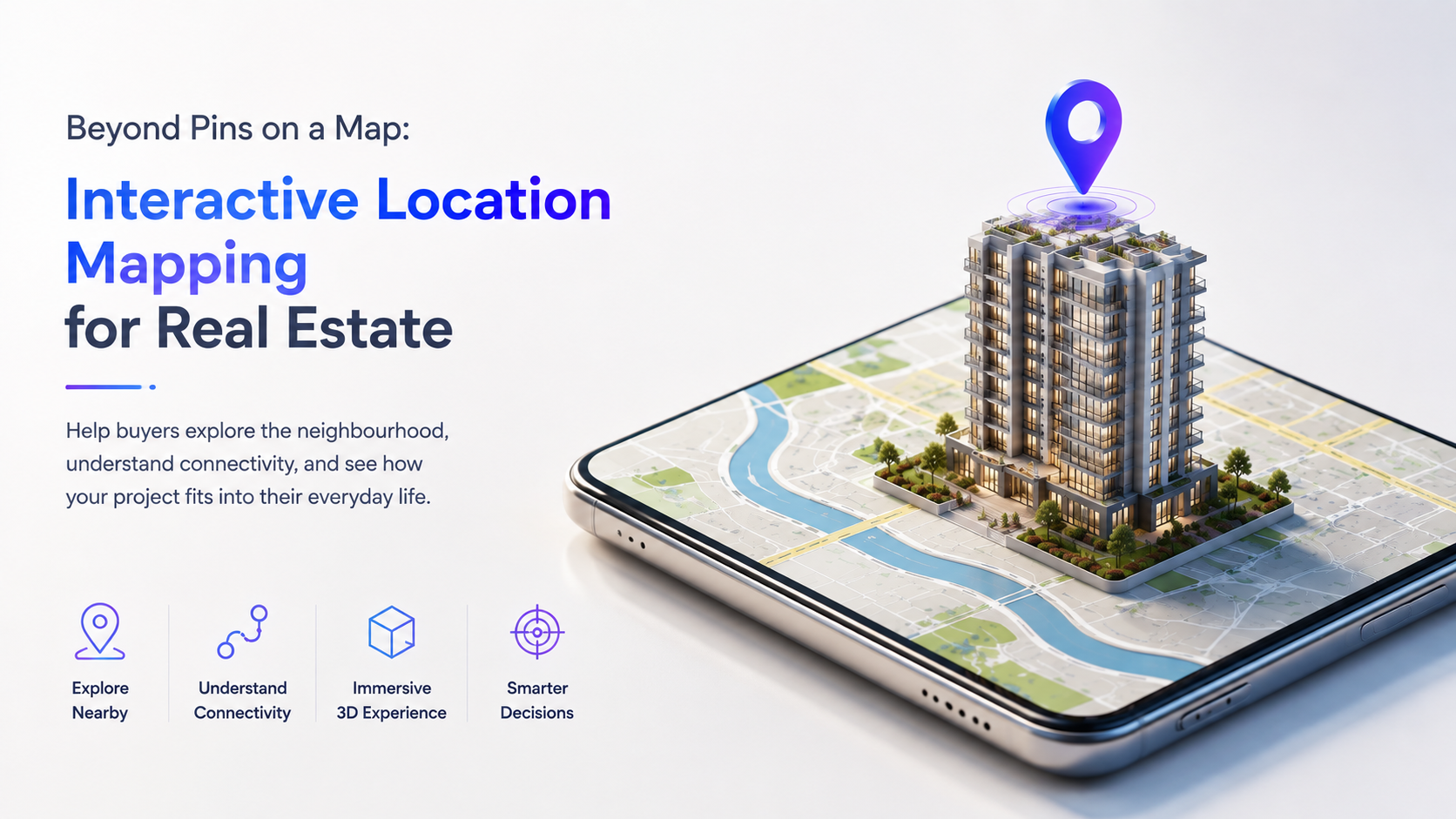
In real estate, location has always been one of the biggest factors influencing a buying decision. Yet most project websites still explain it with a static map and a few pins for schools, hospitals, offices, and landmarks. Interactive location mapping for real estate changes that experience. Instead of simply telling buyers what is nearby, it lets them explore the neighbourhood, understand connectivity, and see how the project fits into their everyday life.
For developers, this creates an opportunity to make location more than a section on a website. It can become an important part of how the project is experienced and evaluated.
Why Traditional Location Maps Are No Longer Enough
A static map answers one basic question: where is the project?
However, buyers usually want to know much more.
How far is the nearest metro station? Which business districts are easily accessible? Where are the schools their children may attend? How does the project connect to major roads? What is coming up around the neighbourhood?
When all of this information is presented through separate icons, lists, or paragraphs, buyers have to connect the dots themselves.
Interactive location mapping for real estate makes those relationships easier to understand by presenting them visually and in context.
Turning Location Into an Interactive Experience
Imagine someone exploring a residential project online. Instead of seeing ten pins placed around a map, they can select categories such as education, healthcare, business hubs, entertainment, or transport.
The map responds to what they want to explore.
They can understand distances, discover important landmarks, and get a clearer picture of the neighbourhood without leaving the project experience.
This is where interactive 3D mapping services for real estate can add another layer of depth. They can help developers present not just points of interest, but the larger surroundings and connectivity in a more engaging visual format.
Helping Buyers Understand Everyday Convenience
A location becomes valuable when buyers can relate it to their own lives.
For a working professional, proximity to an office hub may matter most. A family might focus on schools, hospitals, and recreational spaces. An investor may pay greater attention to infrastructure, commercial developments, and future connectivity.
An interactive map allows each visitor to explore what matters to them.
As a result, the same project location can communicate different benefits without overwhelming visitors with information.
Interactive Location Mapping for Real Estate Marketing
Location is not simply geographical information. It is part of a project’s positioning.
A luxury development may want to highlight premium neighbourhoods, golf courses, hospitality, and business districts. A family-focused project may prioritise schools, hospitals, parks, and daily conveniences. Meanwhile, an emerging location may need to communicate upcoming infrastructure and improve connectivity.
Interactive location mapping for real estate gives marketing teams more control over how that location story is presented.
Instead of displaying everything at once, information can be organised around the project’s strongest selling points. This makes the experience cleaner while keeping the most relevant advantages easy to discover.
Making Sales Conversations More Visual
Interactive mapping can also support sales teams.
Rather than explaining connectivity verbally or moving between maps, brochures, and presentations, sales representatives can take buyers through the location visually.
A buyer asks about the airport. The salesperson shows the route. Another asks about nearby schools. The relevant category can appear instantly.
With interactive 3D mapping services for real estate, these conversations can become more immersive, especially when location mapping is integrated with other interactive project experiences.
From Showing a Location to Selling Its Advantage
A project may have an excellent location, but its value is reduced if buyers cannot quickly understand why that location matters.
That is the difference between placing pins on a map and designing a meaningful location experience.
Platforms such as Propickle help real estate brands turn project information into interactive digital experiences where buyers can explore rather than simply read. When mapping, project visuals, and relevant information work together, the website becomes more useful throughout the discovery process.
Ultimately, interactive location mapping for real estate is about giving buyers context. It helps them see the roads they may travel, the places they may visit, and the conveniences that could become part of their routine.
For real estate brands, that means location no longer has to remain a static section of the website. With solutions such as interactive 3D mapping services for real estate, it can become an experience that helps buyers understand not only where a project is, but what living there could actually mean.
Frequently Asked Questions
What is interactive location mapping for real estate?
Interactive location mapping is a digital way of presenting a property’s location, connectivity, nearby landmarks, and points of interest. Buyers can actively explore relevant information instead of relying on a static map.
How does interactive mapping help real estate buyers?
It gives buyers a clearer understanding of the neighbourhood and its everyday convenience. They can explore nearby schools, hospitals, business hubs, transport links, entertainment destinations, and other important places based on their priorities.
What are interactive 3D mapping services for real estate?
Interactive 3D mapping services for real estate present project surroundings and location information through a more visual and immersive interface. They can help buyers better understand connectivity, landmarks, distances, and the overall context of a development.
Can interactive location maps be integrated into a real estate website?
Yes. Interactive maps can become part of a project’s website or digital sales experience, allowing buyers to explore the location while learning about the development.
How can Propickle improve a project’s location experience?
Propickle can help real estate brands present project and location information through interactive digital experiences. This makes it easier for potential buyers to explore relevant details and understand the project’s location advantages in a more engaging way.