
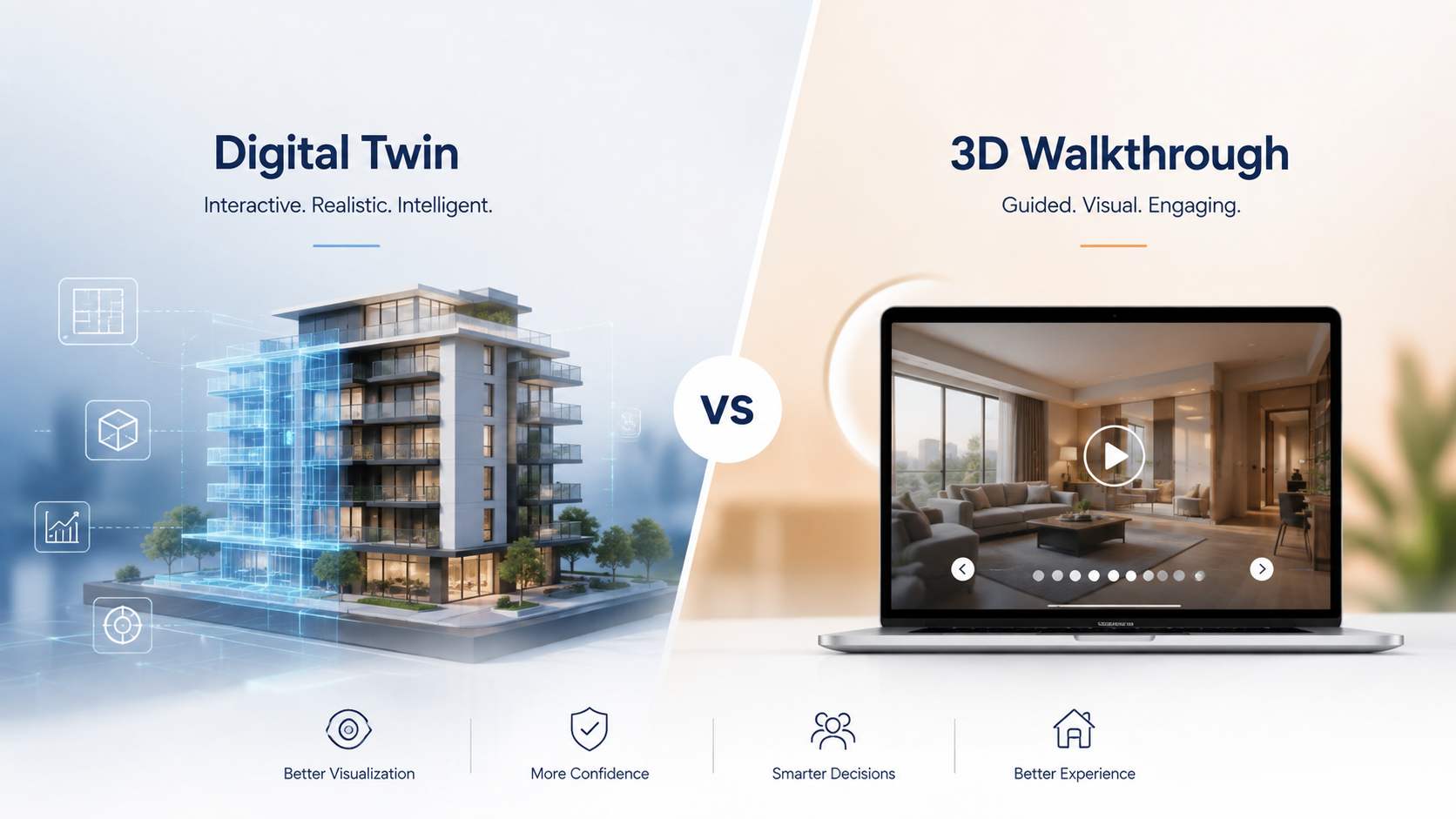
Buying a property is one of the biggest decisions people make. That is why developers are constantly looking for better ways to help buyers explore projects before making a commitment. This is where digital twin technology for real estate is changing the experience. While many people confuse it with a 3D walkthrough, the two serve different purposes. Understanding these differences can help buyers make informed decisions and help developers present projects in a more engaging way.
What Is Digital Twin Technology for Real Estate?
A digital twin is a virtual replica of a physical property or project that mirrors real-world spaces with remarkable accuracy. Unlike a standard 3D model, it captures detailed spatial information and creates an interactive environment that users can explore from any angle.
With digital twin technology for real estate, buyers can move freely through a property, inspect room layouts, understand dimensions, and experience the space almost as if they were there in person. This creates greater confidence, especially for under-construction or premium properties.
What Is a 3D Walkthrough?
A 3D walkthrough is a guided visual presentation of a property. It usually follows a predefined path, allowing viewers to see key spaces through animated scenes or camera movements.
Today, many developers also use web-based 3D walkthroughs for real estate to make project presentations accessible across devices without requiring software downloads. These walkthroughs are excellent for creating first impressions and giving buyers a quick overview of the project.
However, a walkthrough mainly focuses on storytelling rather than exploration.
Digital Twin vs 3D Walkthrough: The Key Differences
Freedom to Explore
A digital twin gives users complete control. Buyers can move between rooms, revisit spaces, zoom into details, and explore the property at their own pace.
In contrast, web-based 3D walkthroughs for real estate generally follow a fixed route. While viewers enjoy a visually appealing tour, they have limited freedom to navigate independently.
Level of Detail
Digital twins capture highly accurate measurements, layouts, and real-world conditions. Every room, corner, and connection between spaces is represented with precision.
A 3D walkthrough focuses more on visual appeal. Furniture, lighting, and interiors may be enhanced to create an attractive presentation, but they do not always provide the same level of spatial accuracy.
Buyer Confidence
One of the biggest advantages of digital twin technology for real estate is trust. Buyers can inspect spaces thoroughly, reducing uncertainty before scheduling a physical visit.
A walkthrough creates excitement, but buyers may still have questions about room sizes, layouts, or accessibility because they cannot freely investigate every area.
Which Option Creates a Better Buying Experience?
The answer depends on the buyer’s stage in the decision-making process.
For attracting attention and generating interest, web-based 3D walkthroughs for real estate work extremely well. They are visually engaging, easy to share, and ideal for marketing campaigns.
When buyers move closer to making a purchase, digital twins become far more valuable. They offer transparency, allow detailed exploration, and help buyers feel confident about what they are investing in.
This combination often leads to faster decision-making and fewer unanswered questions.
Why Real Estate Is Moving Toward Digital Twins
Property buyers today expect more than brochures and static images. They want interactive experiences that help them visualize their future home without relying only on imagination.
As technology evolves, digital twin technology for real estate is becoming an important part of modern property marketing. It improves remote property viewing, supports international buyers, and helps developers present projects with greater credibility.
Companies like Propickle are helping developers adopt these advanced visualization solutions, making it easier to showcase projects in an immersive and user-friendly way.
Can Digital Twins and 3D Walkthroughs Work Together?
Absolutely.
Instead of choosing one over the other, many successful real estate projects use both. A walkthrough captures attention and introduces the project, while a digital twin provides a deeper level of interaction for serious buyers.
This approach creates a smoother customer journey from initial interest to final decision. Platforms like Propickle enable developers to combine immersive experiences with practical property exploration, giving buyers the information they need at every stage.
Final Thoughts
Both technologies play an important role in modern real estate marketing, but they are designed for different purposes. Web-based 3D walkthroughs for real estate are excellent for creating visual impact and generating interest. Meanwhile, digital twin technology for real estate delivers a more immersive, transparent, and interactive experience that helps buyers make informed decisions.
As buyer expectations continue to evolve, adopting the right visualization technology is no longer just an advantage. It is becoming an essential part of delivering a better property buying experience.
Frequently Asked Questions
1. What is the main difference between a digital twin and a 3D walkthrough?
A digital twin allows users to explore a property freely with accurate spatial data, while a 3D walkthrough follows a predefined path designed to showcase the property visually.
2. Why is digital twin technology for real estate becoming popular?
It offers an interactive and realistic property viewing experience that improves buyer confidence and helps developers showcase projects more effectively.
3. Are web-based 3D walkthroughs for real estate suitable for all devices?
Yes. Most web-based 3D walkthroughs for real estate are designed to work directly in modern web browsers, making them accessible on desktops, tablets, and smartphones without requiring additional software.